Fixing Advertising’s Broken Revenue Model: Lessons from the Quartz Crisis
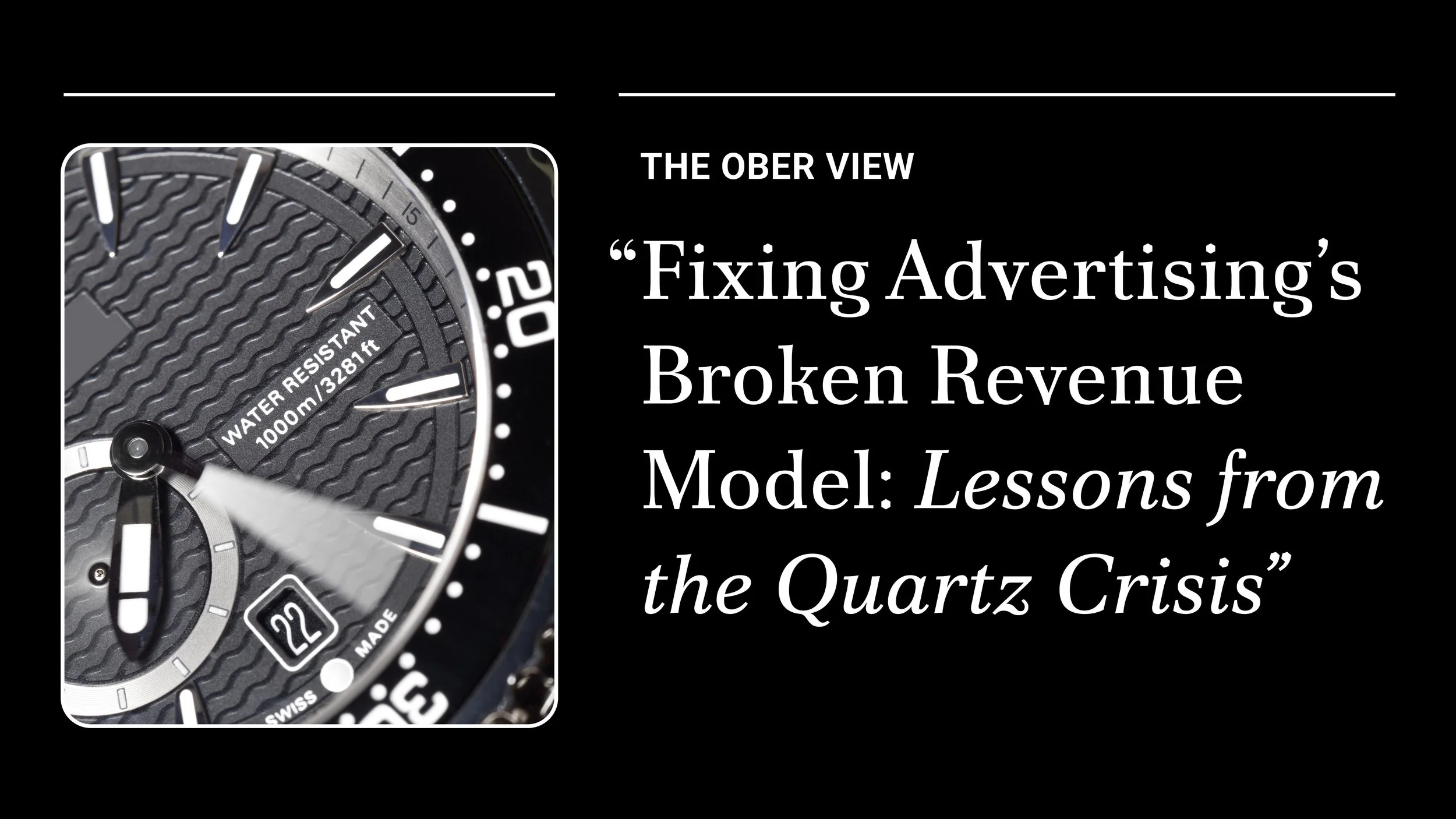
Corporate consolidations, the shocking disappearance of legacy companies and mass layoffs triggered by a technological revolution? I’m talking about the Swiss watch industry in the ‘70s and ‘80s, of course.
It’s that time of year again. Time to stop and take stock of the year that’s just passed and cast our gaze into the hazy middle distance of the year ahead, trying to predict what it might hold.
There will always be a vulnerable hubris to making big “you heard it here first” bets because we live in an archived internet age, where hot takes can be resurfaced years later and proclaimed to have “aged like milk!!” Think of all the “here’s what to expect in 2020” prediction pieces that were thoroughly researched, beautifully written, and probably genuinely insightful, yet turned to lumpy rancid sludge less than a third of the way through that year.
What if we looked to the past for guidance? Might it make more sense to look back at how another industry survived a similar technologically-induced economic shock to the one that we’re all collectively facing?
For over three hundred years, time was kept mechanically by teeny-tiny cogs and springs, and the Swiss were the preeminent force in this endeavour. Accuracy was always a big deal, but so was the romance of a machine that could live and breathe on your wrist without ever needing a battery. Upon seeing a mechanical watch movement for the first time it’s hard not to recognize something biological in the steady oscillation of the balance wheel – the ‘heartbeat’ of the watch that allows it to keep time.
Then, in the late 1960s, quartz arrived.
Quartz watches replaced cogs and springs with circuit boards, no beating heart. They were more accurate and possible to produce cheaply at scale. No centuries of accumulated skill necessary, they just worked. And because they worked better by the narrowest definition of timekeeping, people flocked to them.
The impact on the Swiss watch industry was seismic. Hundreds of brands disappeared as production halved between 1974 and 1983. Employment in the watch industry collapsed from 89,450 to 32,000 in just fifteen years. For a period, it looked as if mechanical watchmaking might fade away entirely. If a watch was defined purely as a device for telling the time as accurately and cheaply as possible, the commercial conclusion seemed inevitable: quartz had settled the matter.
Advertising faces a similar crisis. Ideas are treated as units that can be squeezed in the same way as media impressions or production hours. Shrinking margins reflect this and so does the erosion of stable employment across the industry. The greatest value that advertising produces depends on an accumulation of lived experience. It relies on people seeing something others have missed and articulating it in a way that reframes problems and unlocks solutions. Yet, it is routinely priced as if it were repeatable and abundant.
Our revenue model is broken. We’re selling handmade mechanical watches at quartz prices.
AI didn’t cause this. Like the proverbial frog in the saucepan, we’ve been swimming in water being gradually heated for some time now. AI simply cranked up the gas so high and so fast that we’re finally starting to feel the water getting very noticeably hotter.
When a technology appears that can generate passable advertising quickly and at scale, the economics become difficult to ignore. If advertising is framed purely as the efficient production of messages, fees will continue to fall and roles will continue to disappear. This is why the current moment feels so destabilising. It wasn’t AI that strained advertising’s revenue model, but it might well be the cinder block that breaks the camel’s back.
But I bring you a glimmer of hope: quartz didn’t wipe out mechanical watchmaking.
Instead of trying to out-quartz quartz, the Swiss reframed mechanical watches as artful expressions of human skill. Watchmaking moved away from functional necessity towards being a cultural signal of both value and values. And this was no Luddite response, modern tools played a vital role. An embrace of new technologies like CAD pushed the envelope of what was mechanically possible. The key to this was the emphasis: technology elevating the craft, rather than replacing it.
Today, up to 97% watches sold globally are quartz. At the same time, the Swiss mechanical watch industry is booming, valued at approximately $49.2 billion in 2025. Conceding the mass market freed them to focus on doing what they could do better than anyone else, better than ever before.
The Swiss watch industry survived by separating different kinds of value. Mass-produced quartz watches met functional needs quickly and cheaply. Mechanical watchmaking doubled down on the ineffable allure of human craft. It thrived once it started articulating this distinction clearly. Advertising can do the same. A large portion of communications exists to perform straightforward commercial tasks like tactical or promotional messages. Speed and cost efficiency matter here so AI is already becoming the default tool. That is appropriate, that is progress.
Meanwhile, work that creates long-term brand equity deserves investment because it’s proven to deliver growth for brands. It more than justifies the premium required to sustain human employment. Agencies just need to price this work proportionally to the value it creates rather than by the lowest common denominator.
Purpose emerges naturally from this distinction. We know that young people yearn to connect with brands that serve a social impact role. And, adhering to the most fundamental law of youth, hearing older folk declaring that “purpose is dead” only hastens their embrace of responsible brands that behave in the best interest of animals (that includes us) and the planet.
In a rising sea of slop, high-craft campaigns are a powerful signal of a brand’s faith in human judgment. They telegraph a commitment to participating in culture and shaping it for the better. Investing a bit of time and effort (and yes, money) in communication shows that a brand fundamentally respects its customers. This manifests as a confident swagger. Unlike disposable energy-intensive content, this work endures. It leaves a lasting impression that transcends a single campaign and compounds over time. It’s the kind of work that made us want to get into this industry in the first place, the stuff we point to and wryly ask, “could AI have done that?”
For our clients, the distinction clarifies what they are actually buying. AI can deliver expedience on a budget. Great. Mind-made work delivers cultural relevance and long-term growth. Even better. Premium pricing reflects genuine value as campaigns freed from having to do too many different things all at once become more effective.
The Swiss watch industry learned that conceding the mass market did not mean extinction. They took the high ground, not out of principle but because everywhere else had flooded. And the view from up there turned out to be really rather good. Advertising now faces the same choice. We can continue selling mechanical watches for quartz prices, or we can get clear on what we are truly selling: big ideas that make good money.
Only time will tell whether this prediction ages like a pint of half-and-half or a bottle of ‘82 Latour. Go easy on me in five years’ time if it’s the former because I won’t have a job (not in advertising, at least).
A special thanks must go to Joe Thompson, the author of HODINKEE’s excellent ‘Four Revolutions’ series which offers the most engaging and accessible account of the Quartz Crisis that I’ve come across. If you’re a watch nerd like me and interested in going deeper into the history, it’s well worth your time.