Guy on the Street: Close Encounters of the Third Kind
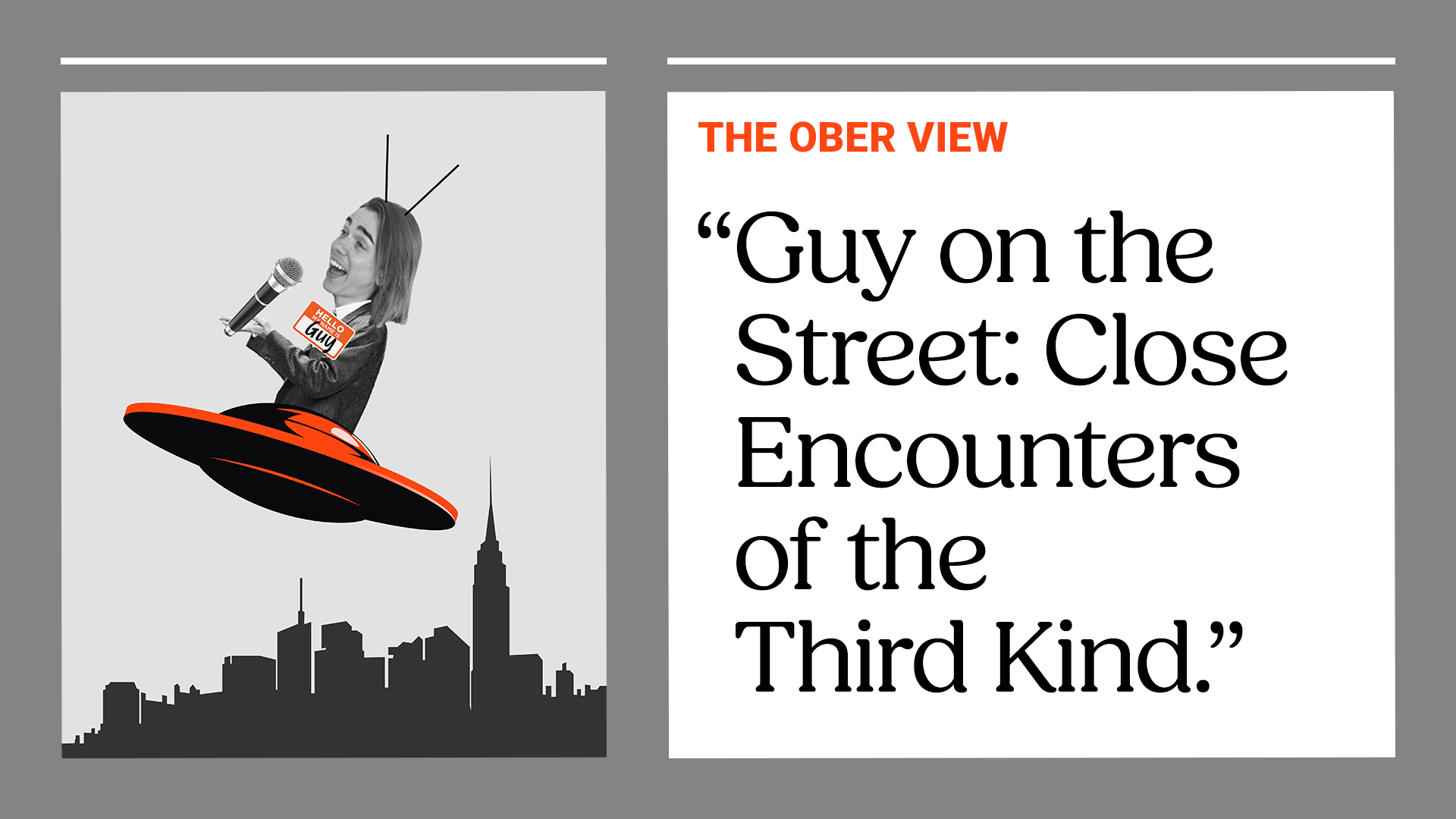
“Whoa-oh, I’m an alien, I’m a legal alien, I’m an Englishman in New York.”
–Sting
Advertising spends a great deal of time confidently telling clients what people think, but the people themselves don’t get a look-in nearly as often. So whenever Danielle and I have a gap in the diary and the weather cooperates, we grab a camera and a microphone and go outside to find some people to talk to. We call it, ‘Guy on the Street.’
“Hi, is now a bad time?”
It’s the first thing I say. I borrowed this opening gambit from former FBI hostage negotiator Chris Voss, who argues that people are wary of saying yes to strangers (rightly so) and much more comfortable saying no. When you phrase it this way, no is the easier answer.
Usually, they say, “no, it’s not a bad time.” Got ‘em.
Next, “great! Can I ask you a question?”
Sometimes, “sure, shoot.” Sometimes, “what’s the question?”
Either way, we’re off to the races.
A street conversation gives you things a research debrief doesn’t. You hear the follow-up qualification that accompanies the first answer and you note the unusual words people choose when they aren’t primed with the pre-approved ‘brand language.’ Sometimes you realize the question was flat-out wrong (New Yorkers have zero patience for stupid questions).
Years ago, in ethnography training with Mark Hadfield of Meet the 85%, I was taught that some of the most powerful questions of all are, “why is that?” “What do you mean by that?” And, “what else?” I was also taught the art of the pregnant pause. The hard part is letting the silence hang because the urge to fill it can be excruciating. But wait just a little longer and people often reward you by saying what they really mean.
For brands, this is where so much untapped value lies. Qualitative interviews alone won’t hatch a strategy but they can reveal when a narrative has become too conveniently tidy, or agency language that bears no relation to how real people actually speak. Sometimes one conversation can hint at a gap between the problem in the brief and the actual problem people in the real world are living. Catch that gap early and you can save a brand from spending a lot of money solving the wrong problem.
In an hour, we might speak to eight or ten New Yorkers. Roughly twice as many turn us down, but that’s ok. Headphones are a reliable warning. Anyone who says, “yes, it really is a bad time” is taken at their word. But the miniature fluffy microphone is recognisable from social media and Danielle’s comically large clipboard confers a certain air of legitimacy. We clip an OBERLAND business card to the mic, deliberately taking our cue from those subway interviewers who stick a MetroCard on theirs. The idea is that people recognise the premise before we have to explain it.
Our latest outing was about affordability, a topic on which inhabitants of one of the world’s most expensive cities certainly aren’t short of opinions. But what never ceases to amaze me is how happy people are to stop and share those opinions.
I think it’s because people aren’t often asked what they think. So this is a rare opportunity for both them and us. The English accent helps too. People seem to find it disarming, and being an Englishman in New York also makes me more at ease asking questions I’d feel much less comfortable asking as an Englishman in, say, London. An alien gets licence to be curious.
Of course, a handful of strangers in Lower Manhattan doesn’t constitute a representative sample of America. But that misses the point. The sample is inherently biased, yes. But through the process I believe I become less biased as a strategist.
Guy on the Street lets me get my reps in. Just like three months selling sunglasses inside Macy’s did when I first arrived in New York. I’d approach maybe a hundred people a day in that job, and the 20% or so that stopped to talk (and sometimes bought sunglasses) taught me so much about my new home.
Nationalities aside, if you work in advertising you’re already somewhat of an alien. The next time we’re tempted to speak confidently for ‘people,’ perhaps we ought to go outside and encounter some.
https://www.instagram.com/reel/DZcoGgyqz8d/?utm_source=ig_web_copy_link&stkn=MzRlODBiNWFlZA==